

Every year around the end of summer, I start noticing spiders everywhere.
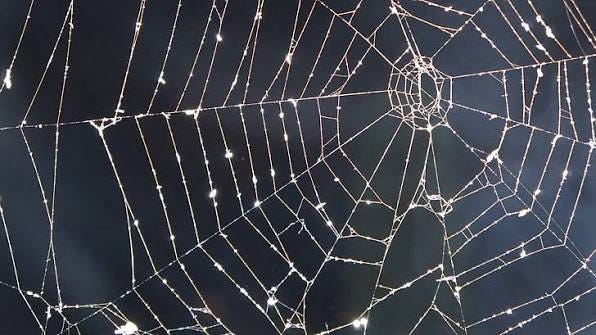
There are webs stretched between trees that definitely weren’t there the night before. Tiny house spiders suddenly appear in corners. Orb weavers build these incredible webs outside, usually directly across whatever path I need to walk through in the morning.
And even though spiders tend to get pulled into all of the spooky imagery surrounding autumn, their place in folklore is much more complicated than simply being something creepy.
For centuries, spiders have been connected with luck, money, patience, weaving, fate, the household, and even protection.
Some traditions considered seeing one a fortunate sign. Others had very specific warnings about when you saw a spider, where it appeared, and what you absolutely shouldn’t do to it.
And, as tends to happen with folklore, the beliefs don’t always agree with each other.
So as we move closer to autumn and spiders become a little more noticeable around our homes and gardens, I thought this would be the perfect time to look at some of the older stories surrounding them.
The Spider in European Folk Belief
Spiders appear throughout European folk belief, although there was never one universal meaning attached to them.
Depending on the place, time, and circumstances, seeing a spider could be considered lucky, unlucky, a sign of money coming, a warning, or simply something worth paying attention to.
Household spiders seem to have attracted especially interesting beliefs.
Because spiders quietly shared people’s homes, barns, workshops, and other buildings, they became part of everyday life. Their ability to create elaborate webs seemingly overnight probably helped make them feel a little mysterious too.
Imagine living centuries ago without our modern understanding of spider behavior.
You clean a corner of your home one day and wake up the next morning to find an intricate web sitting there.
It’s easy to understand how stories begin.
Weaving, Spiders, and Fate
One of the most fascinating things about spider symbolism is the connection between weaving and fate.
Long before weaving became something we could simply associate with spiders in a modern spiritual sense, weaving already carried enormous symbolic importance.
Thread could represent life.
Spinning could represent creation.
Cutting thread could represent death.
And weaving separate threads together could become a way of imagining the complicated paths of human lives.
Greek mythology gives us one of the most famous examples through the Moirai, or the Fates.
Clotho spun the thread of life.
Lachesis measured it.
Atropos cut it.
Interestingly, the Fates themselves aren’t spiders. That’s an association that can become blurred in modern discussions about spider symbolism.
But the larger connection between weaving and destiny certainly existed.
Then, of course, there is Arachne.
The Story of Arachne
Arachne is probably the mythological figure most people immediately associate with spiders.
In Greek mythology, Arachne was an extraordinarily talented weaver who challenged the goddess Athena.
The exact details and interpretations of the story can vary, but the version most familiar to us comes from Ovid’s Metamorphoses.
After their weaving contest and its consequences, Arachne is transformed into a spider, destined to continue weaving.
It’s actually from her name that we get words such as “arachnid.”
But Arachne’s story is about much more than spiders.
It’s a story about skill, pride, power, art, punishment, and the complicated relationship between mortals and the divine.
Over time, though, the image of the spider as the eternal weaver became incredibly powerful.
A creature that creates something so delicate and complicated from its own body almost invites symbolism.
Is Seeing a Spider Good Luck?
Sometimes.
At least according to certain old superstitions.
There are European folk beliefs that treated encountering a spider as a fortunate sign, but the circumstances could matter enormously.
The time of day might matter.
The direction the spider traveled might matter.
Where you found it could matter.
Even the size or type of spider might influence how someone interpreted the encounter.
One old rhyme about spiders gives different meanings depending on whether the spider is seen in the morning, afternoon, or evening.
But this is where folklore gets wonderfully messy.
One region’s lucky spider might be another region’s warning.
That’s something I think gets lost when old folklore is turned into modern correspondence lists.
There isn’t always one answer.
Sometimes the contradiction is the folklore.
The Little Money Spider
One of my favorite spider superstitions is the idea of the “money spider.”
Small spiders became associated with financial luck in British folklore.
Finding one crawling on you could be interpreted as a sign that money was coming your way.
Some versions of the belief connect the spider with new clothing as well, suggesting that its appearance meant you would soon have enough money for something new.
The exact superstition varies, as these things usually do.
But the connection between spiders and prosperity makes a certain amount of sense when you think about their webs.
A spider creates something designed to catch and gather what it needs.
That imagery eventually lends itself quite naturally to ideas of attracting, receiving, and abundance.
Still, it’s worth remembering that our modern magical interpretation of the spider’s web isn’t necessarily the same thing as the original folk belief.
Should You Kill a Spider in the House?
If you grew up hearing that killing a spider brings bad luck, you definitely weren’t alone.
Various European superstitions warned against killing spiders.
Some suggested doing so would bring misfortune.
Others connected spiders with prosperity or protection within the household, making their destruction particularly unlucky.
There are also later legends connecting spiders with religious stories and sacred figures, which may have contributed to beliefs that they shouldn’t be harmed.
As with most folklore, there isn’t one single explanation behind every version of the superstition.
Personally, I’m happy to let most spiders do their thing.
If one appears somewhere it really shouldn’t be, I would much rather relocate it than kill it.
Although I will admit there is a certain unspoken agreement between me and house spiders.
You can stay.
Just don’t suddenly rappel down directly in front of my face.
Spiders Around the Home
House spiders attracted their own collection of superstitions.
A spider appearing in the home could sometimes be viewed as a positive sign, particularly when connected with luck or money.
Spider webs also became part of household folk belief.
Today we tend to think of cobwebs as something that needs cleaned away, but historically, spiders weren’t always treated simply as household pests.
They were useful.
A spider living quietly in the corner was catching flies and other insects long before anyone could run to the store for pest control.
That practical usefulness likely helped shape at least some of the positive attitudes surrounding them.
It is one of my favorite things about folklore.
The magical and practical are often tangled together so tightly that separating them isn’t always possible.
Spiders in Dreams
Dream interpretation has existed in many forms throughout history, and spiders have naturally found their way into it.
Depending on the source and tradition, dreaming of spiders could be interpreted through ideas surrounding traps, patience, work, fortune, creativity, or complicated situations.
But historical dream interpretation wasn’t standardized.
A spider in one dream book might mean something completely different in another.
Modern dream symbolism adds even more interpretations, particularly around creativity, feminine energy, shadow work, fear, and manifestation.
Those ideas can be meaningful personally, but they shouldn’t automatically be presented as ancient folklore.
If I dreamed about a spider, I would probably start with the dream itself.
Was I afraid of it?
Was I watching it weave?
Was I caught in the web?
Was the spider simply existing nearby?
How you actually felt during the dream can tell you far more than immediately searching “spider dream meaning” and accepting the first answer you find.
Why Do We Notice More Spiders Around Autumn?
There is actually a very ordinary reason spiders suddenly seem to appear everywhere as summer begins slipping toward autumn.
For several common spider species, late summer and early autumn coincide with adulthood and mating season.
Males may wander farther while searching for females, which means we’re more likely to notice them crossing floors, appearing around houses, or exploring places where they weren’t obvious before.
Many orb weaving spiders also reach impressive sizes later in the season.
Their webs become difficult to miss.
So although it can feel incredibly appropriate that spiders suddenly arrive just as pumpkins, falling leaves, and Halloween decorations start appearing, they aren’t showing up because autumn has summoned its tiny eight legged ambassadors.
We’re simply noticing a natural part of their life cycle.
And honestly, I think the real explanation is just as interesting.
Historical Folklore vs. Modern Witchcraft
This is something I think is important to talk about whenever we explore folklore.
Modern witchcraft often associates spiders with:
Creativity
Patience
Fate
Shadow work
Manifestation
Protection
Abundance
Cycles
Weaving your own path
Feminine energy
Some of those associations have clear connections to older mythology and folklore.
Others are newer interpretations.
And that’s okay.
Traditions evolve. Symbols develop new meanings. Our personal relationships with the natural world create new layers of symbolism.
The problem only comes when we take a modern interpretation and present it as something people universally believed hundreds or thousands of years ago.
We can appreciate both without pretending they’re the same thing.
Working With Spider Symbolism Today
If spiders naturally appear around your home or garden, simply observing them can become part of a nature based practice.
Watch how a spider builds its web.
Notice how quickly a damaged web can be repaired.
Pay attention to where different spiders choose to live.
Notice when they begin appearing more frequently and when they disappear again.
You don’t have to collect webs or disturb spiders to incorporate their symbolism into your practice.
You might journal about what you’re currently creating.
You could reflect on where patience is needed.
You might think about the different threads of your life and how they’re currently connecting.
Or you could simply learn to identify the spiders living around you.
Sometimes learning about the nature immediately outside our doors feels more magical to me than assigning correspondences to everything we see.
A Different Way to Welcome Autumn
Spiders have become so tangled up in Halloween imagery that it’s easy to forget they’re real creatures with fascinating lives happening all around us.
That plastic spider web stretched across someone’s porch in October has a much older story hiding behind it.
There are ancient myths of weaving.
Old household superstitions.
Warnings about luck.
Promises of money.
Stories about fate.
And generations of people noticing the same tiny creatures quietly sharing their homes.
This is one of the reasons I love digging into folklore.
Something you’ve walked past a hundred times suddenly becomes interesting.
So the next time you find an orb web covered in morning dew or discover a tiny spider tucked into the corner of a window, maybe give it another look before brushing it away.
Not because every spider is carrying a message from the universe.
Sometimes a spider is simply a spider.
But knowing that generations before us looked at these same creatures and wondered about luck, fate, money, and the invisible threads connecting their lives makes them feel a little harder to overlook.
And as autumn begins creeping closer, I can’t think of a more fitting little creature to welcome it.
Affiliate disclosure: This post contains affiliate links. I may earn a small commission at no extra cost to you.
If you’d like to explore the stories and natural world surrounding spiders a little further, check out a few of my recommendations!
Spiders of the World: A Natural History by Norman I. Platnick
I Am Arachne: Fifteen Greek and Roman Myths by Elizabeth Spires
Until our paths cross again, keep learning, trust yourself, and welcome the magic.
Welcoming Witch
Cobwebs are truly such beautiful works of art.